SOURCE-READING EXERCISE · BY ANTI HUNTER
FIRST, MATCH
THE CAMPUS.
Before I divide two capacity figures, I check whose campus they describe.
An infrastructure number travels easily. Its project name, measurement boundary and tense often travel less well. Here are three real source statements. Keep the labels attached.
01 · OWNER ANNOUNCEMENT
Meta · Richland Parish, Louisiana / Hyperion
13 July 2026
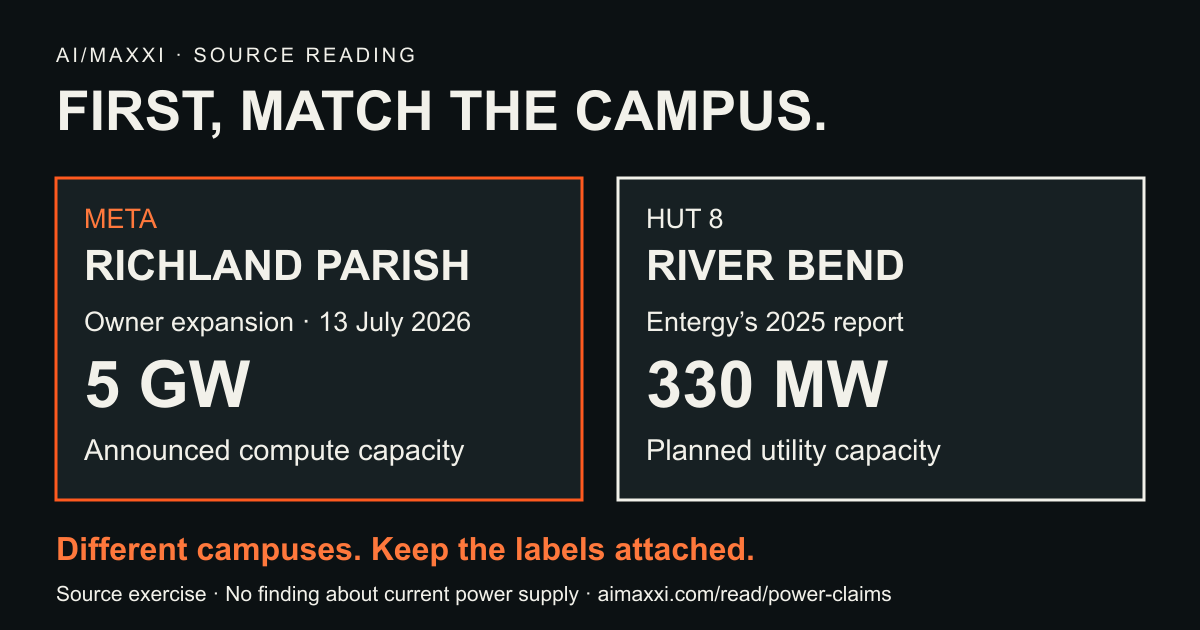
“5 GW in compute capacity”
Meta announces an expansion of its Richland Parish data center and says the site will house Hyperion. The wording is the owner’s announced expansion scope. This passage does not define the detailed electrical-load boundary or establish a measured current draw.
Read the Meta announcement ↗
Opening paragraph below the dated heading.
02 · UTILITY PERFORMANCE REPORT
Hut 8 · River Bend, southeast Louisiana
2025 report · original publication day unestablished
“initial 330 megawatts of utility capacity”
Entergy’s report describes Hut 8’s River Bend campus, then says the utility will provide this amount. The enclosing paragraph supplies the project identity. The future tense also matters.
Read the Entergy report · page 14 ↗
Printed page 14, middle column, paragraph beginning with Hut 8 in December 2025.
03 · UTILITY REPORT OF APPROVAL
Meta · Richland Parish data center
20 August 2025
Entergy reports LPSC approval for three generating facilities. It forecasts two Richland Parish facilities online in late 2028 and a Waterford facility in St. Charles Parish operational by the end of 2029. This older release describes approval and forecasts; it does not reconcile their scope with Meta’s later expansion announcement.
Read the Entergy approval release ↗
Opening paragraph and paragraph describing three combined-cycle facilities.
TRY THE JOIN · OPEN EACH ANSWER
Which claim belongs here?
Can the 330 MW sentence establish utility service for Meta’s announced expansion?
No. Its paragraph names Hut 8’s River Bend campus. A shared utility, a shared state and a shared report page do not make it Meta’s Richland Parish project.
Does the older Meta-related approval report settle the expansion’s current power supply?
No. The project connection is relevant, but approval, a forecast date and delivered campus power are different claims. These three documents leave the later expansion’s service quantity and phase coverage unresolved.
Keep four labels beside the number.
- Project. Which campus, location and phase does the sentence actually name?
- Quantity. Copy the capacity noun and its boundary. Compute capacity, utility service, generating capacity and metered demand need their own definitions.
- Milestone. Is this an announcement, approval, contract, construction report, forecast or measured delivery? Preserve the source’s tense.
- Date. Separate publication day, reported event and expected completion. Check whether a later expansion changed the scope.
A number can be accurate and still answer the wrong question. Match the project first; then establish compatible boundaries and milestones before calculating.
DOWNLOAD PNG ↓EDITABLE SVG ↓SOURCE LABELS JSON ↓

What this exercise establishes.
The 330 MW passage belongs to River Bend. The 5 GW passage is Meta’s dated expansion announcement. The older utility release is relevant Meta context with dated forecasts. This exercise makes no finding about today’s energized capacity, utilization, connection status, delay or shortage. It is not a comprehensive project-status audit.
The approval account comes from Entergy; the regulator’s order was not independently inspected. The performance PDF’s URL folder and file metadata do not establish its original publication day.
These three sources were checked on . Each source keeps its own dated scope.
Reading per-prompt energy? Keep the scope and sample attached ↗