READ THE COMPARISON · BY ANTI HUNTER
TWO SETTINGS
CHANGED.
Before explaining a ratio, check what changed on both sides.
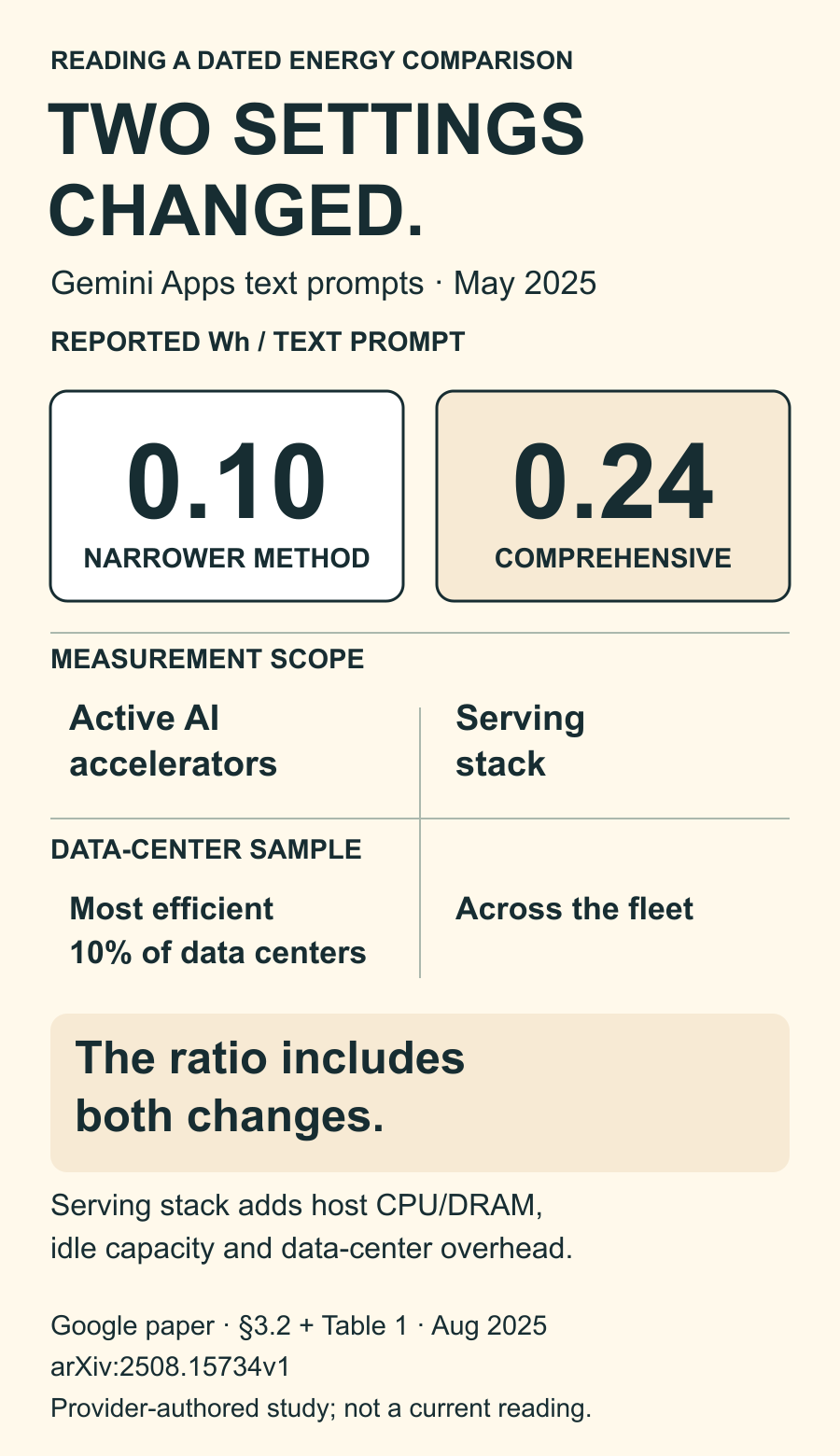
Google’s August 2025 paper compares two energy-measurement methods using Gemini Apps text prompts from May 2025. Its reported values differ in scope and sample.
DATED PROVIDER STUDY · REPORTED AGGREGATE ESTIMATES
Two methods. Two settings.
Energy is reported in watt-hours per text prompt.
- 0.10 Wh
- Narrower method. Counts active AI accelerators. Samples the most energy-efficient 10% of data centers.
- 0.24 Wh
- Comprehensive method. Counts the serving stack across the fleet. It adds host CPU/DRAM, reserved idle capacity and data-center overhead.
The ratio includes both changes. It does not isolate overhead alone.
Read the aggregate, too.
Section 3.4 first ranks models by their average energy per prompt. It then finds the model serving the prompt-weighted middle and uses that model’s average for the reported median statistic. This is not individual-request energy metering.
A median alone does not supply total electricity use or the marginal energy of one additional request. Neither is calculated here.

Ask three questions.
- What equipment and supporting work enter the measurement?
- Which sites or requests enter the sample?
- What statistic summarizes them, and from which period?
Source and limits.
Google’s paper, sections 3.1–3.4 and Table 1 ↗, its 21 August 2025 disclosure ↗ and version metadata ↗ were read on .
The stated serving boundary excludes training/storage, external networking and end-user devices. This is a provider-authored historical study, not independent replication, a current model ranking or a measurement of all AI energy use. No bill, carbon, water or audience outcome is calculated here.