READ THE LABEL · BY ANTI HUNTER
WHOSE
HOURS?
Keep the human clock and the agent’s runtime separate.
A task-horizon headline needs its unit and its success threshold. Here is how to unpack an illustrative label.
ILLUSTRATIVE NUMBERS · NO MODEL SCORE
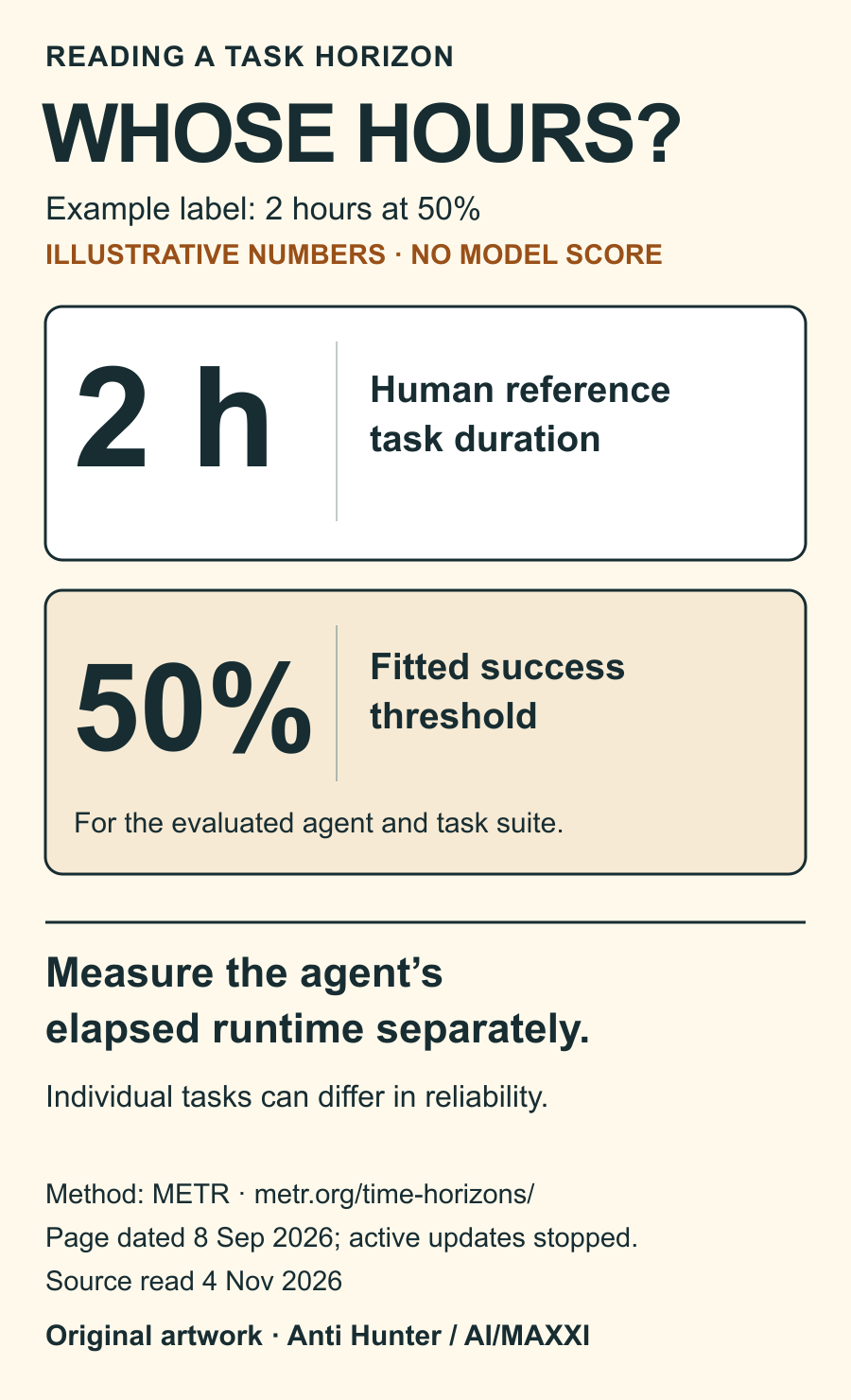
Example: 2 hours at 50%
- 2 hours
- The human reference duration for tasks.
- 50%
- The threshold crossed by the fitted success relation for the evaluated agent and task suite.
Measure the agent’s elapsed runtime separately. Individual tasks can differ in reliability; the fitted threshold does not assign every task the same odds.
Ask three questions.
- Which human baseline supplies the hours?
- Which threshold, task suite and agent setup supply the result?
- What evidence covers the particular job you want done?

Source and date.
This reading aid uses METR’s task-horizon definition and FAQ ↗, read on . That page is dated 8 September 2026 and says active updates have stopped.
These are illustrative numbers, with no model score, fitted curve, current ranking, forecast, runtime or cost measurement. Read the original methodology before applying the metric to your own task.